


AI budgets, in our experience, are often built backward. BCG finds that people and process drive roughly 70% of the value in AI initiatives,(1) yet many companies we encounter concentrate their spending and attention on the technology. In our work with portfolio companies, we see a pattern: when AI spending underdelivers, the constraint is rarely the technology itself. More often, it lies in the organization around the technology, including who owns the effort, how knowledge accumulates and how talent develops. The companies we see getting this right are changing how they structure AI work, how they hire and develop people, and how leaders themselves engage.(2)
How should growth companies structure AI work?
We recommend that growth companies build AI into how the business operates rather than layering it on top, through several organizational moves. First, give the work a home. Connect the systems that hold company knowledge, define repeatable workflows tied to customers and revenue, and put the AI capability where people already work. Second, put someone in charge. A model we see working well pairs a small central group, accountable for reliability and quality, with champions inside each function; the combined team is funded with real budget, and progress is measured against the operating metrics each workflow is meant to move. Adoption on its own is a cost, not a result. Finally, treat data readiness as the price of admission, fixing the data each priority project needs rather than waiting for everything to be perfect.
“The scarce skill is no longer knowing how to use these tools; the tools are increasingly table stakes. It is knowing how to change the way your company structures its work around them,” says Ashwin Subramani, Summit’s Head of AI. “That is an organizational capability, and it needs to be built as deliberately as any product.”
How is AI changing hiring and talent development models?
When companies reorganize work, roles change too. The companies we see managing this transition well are backfilling capabilities, not roles. Before replacing a departure, these companies ask which tasks have disappeared, whether the role still needs to exist and what capability to add instead. The logic applies to both experienced and entry-level roles. For early-career professionals, we’ve seen AI absorb routine work that has traditionally defined junior roles, but rather than eliminating these roles, it is changing what these companies are hiring for. Employers surveyed by the National Association of Colleges and Employers this spring reported that more than one-third of entry-level jobs at their respective companies now require AI skills — nearly triple the share reported in fall 2025.(3) And because capabilities can be built as well as bought, many companies are investing inward; the companies BCG identifies as furthest along in AI maturity direct approximately 60% of their AI budgets to training and upskilling, versus roughly 25% at other companies.(4)
“You cannot hire your way to an AI-ready organization,” says Dayton Ogden, Head of Talent & Recruiting at Summit Partners. “The companies we see doing this well are explicit about the capabilities they will need next, and they are focused on developing many of those skills internally, even as they recruit.”
Hiring is being rebuilt on the same principle. “The interview has to look like the job,” says Tim Kohn, Summit’s Technologist-in-Residence. “Give candidates access to the tools they will use every day on the job, and watch how they frame the problem, verify the output and defend their decisions. That is where I’ve seen strong engineers distinguish themselves.”
What role should leadership play in AI adoption?
Leaders should be among the most active AI users in their companies. Those companies we see making meaningful progress have leaders who use the tools themselves, and that hands-on use can help them judge what is real and model the change they are asking for. It can also compound what good leaders already have — namely, deep functional knowledge — which better informs where AI should change the work. The rest of the job is structural, hinging on decisions only leadership can make: naming one accountable owner, defining what proficiency means role by role, and making successes visible enough that other teams copy them.
Is your company organized for AI?
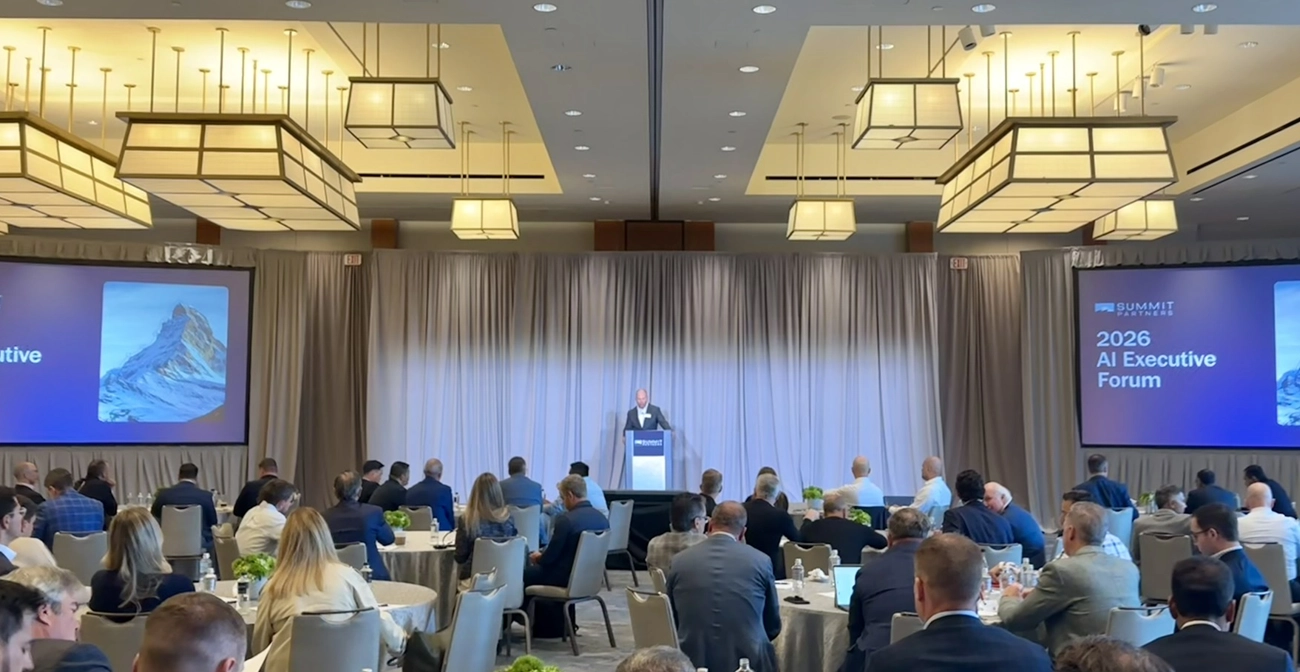
Readiness shows up when AI moves from individual experimentation to shared, company-wide workflows. Summit-backed CoderPad offers a useful example. The company, whose platform hosts technical hiring for more than 4,000 businesses,(5) began its AI effort the way many growth companies do: licenses and training for everyone. Adoption appeared healthy, yet fewer than 5% of employees built anything their colleagues could reuse; the gains made by motivated individuals stayed personal, at risk of walking out the door with the people who created them.(5) CoderPad’s response was organizational rather than technical: a shared system with a named owner, connected to company knowledge, with workflows designed for specific jobs. Within four and a half months, 85% of employees were active users.(5) “The AI change is not an IT rollout,” CEO Amanda Richardson told our Executive AI Forum this fall. “This is a culture change.”
Heading into 2027, we believe growth-stage management teams should consider the following organizational questions: Who owns AI in your company, and does that owner have real budget? What does AI proficiency mean for each role? And what role are you, as a leader, playing in AI adoption and value creation? The companies best prepared to answer may not be the ones that adopted AI first, but the ones that reorganized around it.
For more of our perspective on how growth companies are navigating AI — including key learnings from Summit's 2026 Executive AI Forum and a closer look at the technical talent market — visit our Resources page.
Growth Timeline
Don't delete this element! Use it to style the player! :)


About the Authors
As part of Summit Partners' Peak Performance Group, our Talent & Recruiting and AI, Technology & Data Science professionals work hand-in-hand with portfolio companies to help build the talent strategies and technical hiring capabilities needed to drive meaningful AI adoption across their organizations.
Read more Summit-authored insights focused on helping growth company leaders understand, apply and scale AI within their organizations.
Related Experience
Related Content




Sources and Disclosures
(1) BCG, “What’s Driving AI Value,” January 2026.
(2) Reflects Summit Partners’ observations drawn from ongoing dialogue with portfolio company management, board participation and periodic financial and operating reports. Such observations are qualitative and subjective, are based on information that is self-reported or anecdotal in nature and has not been independently verified by Summit in every instance, and describe observed associations rather than causal relationships. They are not representative of the experience of all Summit Partners portfolio companies or of the broader market and are not indicative of investment performance or future results.
(3) National Association of Colleges and Employers, “Job Outlook 2026 Spring Update,” April 2026.
(4) BCG, “As AI Investments Surge, CEOs Take the Lead,” AI Radar 2026, January 2026; BCG, “CEOs Are Taking Charge of AI,” Weekly Brief, January 20, 2026.
(5) CoderPad company data shared at Summit Partners’ 2026 Executive AI Forum; figures as of August 2026. Statistics herein are based on unaudited company-provided data comparing results measured before and after the changes described. Such data have not been independently verified by Summit Partners and no representation is made as to accuracy or completeness. CoderPad is a Summit Partners portfolio company.
The content herein reflects the views and opinions of Summit Partners and is intended for executives and operators considering partnering with Summit Partners. References to specific portfolio companies and their reported results are provided for illustrative purposes only, were selected based on relevance to the topics discussed and not on the basis of performance, and are not representative of all Summit Partners portfolio companies or investments; reported results are self-reported by the companies involved. The information herein, including information based on or derived from third-party sources believed to be reliable, has not been independently verified by Summit Partners or an independent party, and Summit Partners makes no representation or warranty as to its accuracy or completeness. Such content and information should not be construed or relied upon as an indication of future results or other future outcomes. This content is provided for informational purposes only and does not constitute, and should not be construed as investment, legal, tax or other advice, or an offer to sell, or a solicitation of an offer to buy, any security or investment product.
The information herein contains forward-looking statements and projections, including statements regarding market trends, anticipated outcomes of AI deployments, the potential benefits of AI adoption, organizational and hiring trends, and third-party forecasts and projections reproduced herein. Forward-looking statements are based on current expectations, assumptions and beliefs of Summit Partners as of the date hereof and are subject to known and unknown risks, uncertainties and other factors that may cause actual results, performance or outcomes to differ materially from those expressed or implied. Such statements reflect Summit Partners’ views as of the date of publication and Summit Partners undertakes no obligation to update or revise any forward-looking statement to reflect new information, subsequent events or changed circumstances. Forward-looking statements should not be relied upon as a guarantee, prediction or definitive statement of fact, and are not intended to represent projections of future fund performance or returns. Past observations and outcomes described herein are not necessarily indicative of future results.
Get the Latest from Summit Partners
Subscribe to our newsletter to stay up to date on our partners, portfolio, and more.